What does Hotel California really mean?
The song everyone hears differently
By the Eagles’ own account, “Hotel California” is about excess in 1970s Los Angeles and, beyond it, about what Don Henley calls “the dark underbelly of the American dream”. The hotel is a metaphor, not a real place. The song is not about Satanism or a mental hospital, and “colitas” is Mexican slang for the buds of the cannabis plant.
For fifty years, people have checked into Hotel California and argued about what they found there. A church of Satan. A mental hospital. The pink hotel on the album cover. The Eagles wrote one of the best-known songs in rock, and then spent decades watching listeners write their own meanings into it.
What is Hotel California about?
The band has been unusually direct about it. The Eagles called the song their “interpretation of the high life in Los Angeles”. Don Henley later widened the frame: “It’s not really about California; it’s about America. It’s about the dark underbelly of the American dream. It’s about excess, it’s about narcissism. It’s about the music business.” In the 2013 documentary History of the Eagles he put it more simply still: “a journey from innocence to experience … that’s all.”
None of the Eagles was from California. Don Felder remembered the band driving into Los Angeles at night and seeing “this glow on the horizon of lights”, and the song grew out of that feeling: the dream visible from the freeway, and what it turned into up close. Henley summed up those years as “the end of the innocence, round one”.
Glenn Frey supplied the story. A traveller, tired from a long drive across the desert, pulls in for the night and finds himself in “a weird world peopled by freaky characters”. Frey and Henley wanted it to “open like an episode of the Twilight Zone”, and modelled it on John Fowles’s novel The Magus, in which every door opens on a new version of reality. Frey said the finished song had “achieved perfect ambiguity”, which explains most of what came next.
Is Hotel California a real hotel?
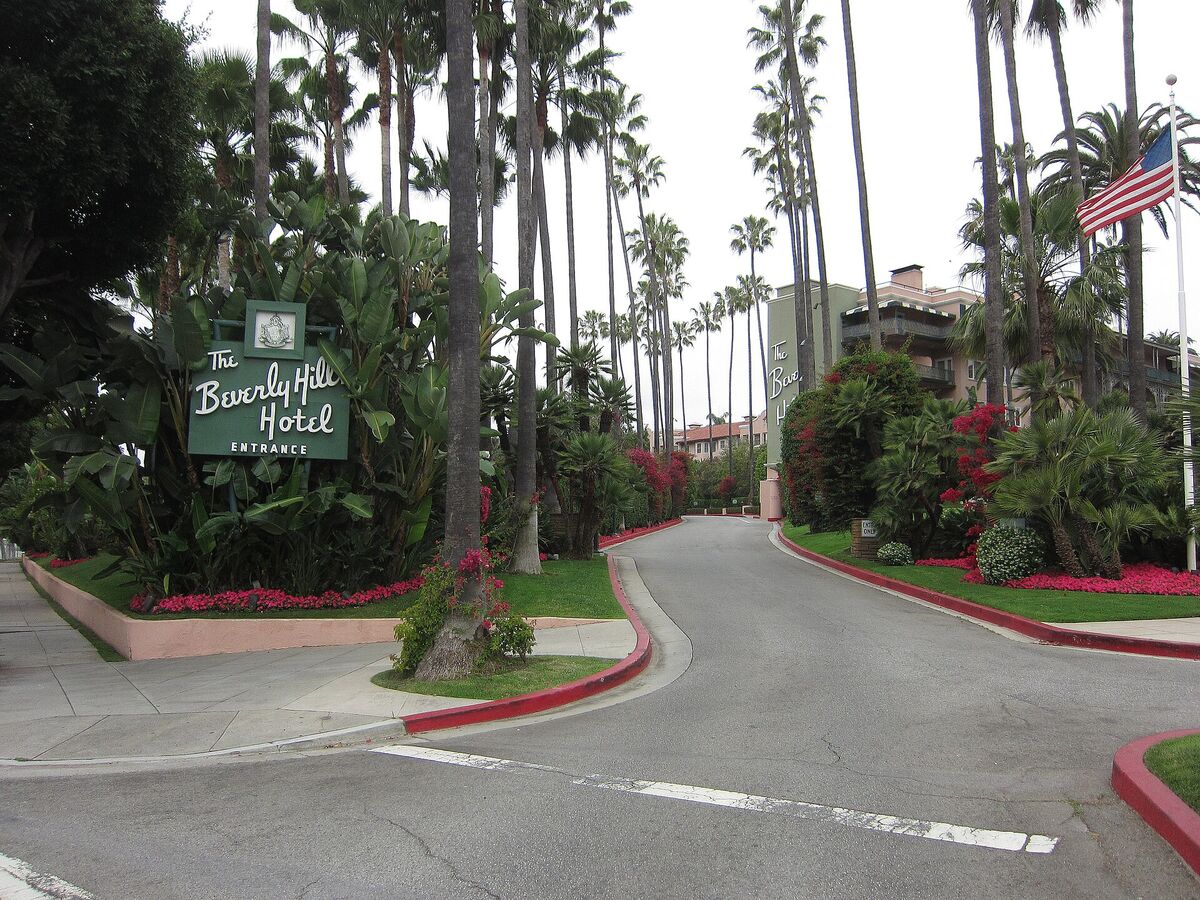
No, though a real one stands behind it. Henley said The Beverly Hills Hotel had become “a literal and symbolic focal point” of the band’s lives at the time, “the locus of all that LA had come to mean for us”. That is the building on the album cover, photographed by David Alexander just before sunset from a cherry-picker 60 feet above Sunset Boulevard.
Henley had asked the designer, Kosh, to portray the hotel “with a slightly sinister edge”. Three hotels were photographed and the Beverly Hills Hotel was chosen. Seen from that unfamiliar height in fading light, most people didn’t recognise it, and when they did, the hotel threatened legal action. The lobby on the back cover and in the gatefold is a different hotel again, the Lido in Hollywood, filled for the shoot with the band and their friends: “people on the edge, on the fringes of society”, as Henley put it. The song itself never names a town.
Is Hotel California about Satanism?
This is the most persistent rumour, and it has a specific origin. In the 1980s a Wisconsin pastor, the Rev. Paul Risley, claimed the song described a San Francisco building bought by Anton LaVey and turned into his Church of Satan, and that the record hid backwards messages about Satan. Listeners pointed to the “steely knives” that “just can’t kill the beast”, and to a shadowy figure on the balcony above the lobby in the gatefold photograph, whose identity has fuelled speculation ever since.
There is no evidence for any of it. Don Felder, who wrote the music, denied it again in 2019, saying the song was about “the underbelly industry in Los Angeles, how it can be less than beautiful”. Another rumour holds that the hotel is the Camarillo State Mental Hospital, which closed in 1997 and was redeveloped into California State University Channel Islands. The band has never given that one any support either.
What are the “steely knives”?
A joke between bands. According to Glenn Frey’s liner notes, “steely” is a nod to Steely Dan, who had sung “Turn up the Eagles, the neighbors are listening” in their song “Everything You Did”. Frey also credited Steely Dan’s bold, strange lyrics with encouraging the Eagles to go “out there” on this one.
What does “colitas” mean?
The “warm smell of colitas, rising up through the air” in the first verse has two explanations from inside the band. “Colitas” means “little tails” in Spanish, and in Mexican slang it refers to the flowering buds of the cannabis plant; Frey described it as “the very top of the plant”. Felder remembered it differently, as a desert plant that blooms at night with “this kind of pungent, almost funky smell”. Both agree it was Henley’s word.
What does “we haven’t had that spirit here since 1969” mean?
Wine is fermented and spirits are distilled, and pedants have been pointing this out to Henley for decades. When the music critic John Soeder raised it in 2009, Henley replied that the line “has little or nothing to do with alcoholic beverages. It’s a sociopolitical statement.” The writer Steve Sullivan reads the missing “spirit” as the social activism of the 1960s, which the pop music of the mid-1970s had turned away from.
What does “you can check out any time you like, but you can never leave” mean?
The last line of the lyric is the song’s thesis: a place you are free to leave in theory but not in practice. It has become shorthand far beyond music. An economist used it for countries that attract foreign investors easily but make it costly to take money out, and the “Hotel California effect” was applied to investors trying to get their money out of China. Commentators have since used it for leaving social networks and cloud computing services, and, during the Brexit negotiations, the European Union.
Who wrote Hotel California?
The music came first. Don Felder made an instrumental demo in a rented house on Malibu Beach, with a Rhythm Ace drum machine, a 12-string guitar and a bassline on a four-track deck, and gave copies to Henley and Frey. Henley said it sounded “like a Mexican reggae or Bolero”, and “Mexican Reggae” became its working title.
Henley then wrote most of the words, driving out into the desert for ideas and drawing on films and theatre. Some lines, like “Her mind is Tiffany-twisted, she got the Mercedes bends”, came from his break-up with his girlfriend Loree Rodkin. The band recorded the song three times, twice at the Record Plant in Los Angeles and finally at Criteria Studios in Miami, lowering the key from E minor to B minor to suit Henley’s voice. The released version was spliced together from the best takes, with 33 edits on the master tape.
Who plays the guitar solo?
Both Felder and Joe Walsh, trading lines on a Gibson Les Paul and a Fender Telecaster before harmonising together. Getting it right took them about three days. They began by improvising, but Henley insisted that the solo follow Felder’s original demo; according to the producer Bill Szymczyk, some of their improvised licks still made the final cut. Readers of Guitarist magazine voted it the best guitar solo of all time in 1998.
The lyrics that went to court
The song’s strangest chapter came decades later. In 2022 a rare-book dealer and two memorabilia specialists were charged in New York over around a hundred pages of handwritten lyric drafts from the album, on yellow notebook paper, which prosecutors said had been stolen from Henley and were worth about $1 million. The pages had passed through Ed Sanders, a writer who began an Eagles biography in 1979 that was never published.
Henley testified in February 2024 that he had never given the pages away. On 6 March 2024 prosecutors dropped the case midtrial, telling the judge that newly released emails supported the defence’s questions about the fairness of the trial.
Myths and facts
| The myth | What the record shows |
|---|---|
| The hotel is a real place you can visit. | The cover shows the Beverly Hills Hotel, but the hotel in the song is a metaphor and is never placed anywhere. |
| It’s about the Church of Satan. | The claim began with a 1980s sermon. Don Felder has denied it. |
| It’s about a mental hospital. | The Camarillo State Mental Hospital rumour has no support from the band. |
| Anton LaVey is on the gatefold balcony. | The figure’s identity has never been established. |
| “Spirit” is a mistake about wine. | Henley says the line is “a sociopolitical statement”. |
| The solo was improvised in the studio. | Henley insisted it follow Felder’s demo, though some improvised licks were spliced in. |
Timeline
- 8 Dec 1976The album Hotel California is released.
- 22 Feb 1977The title track is released as a single.
- May 1977It reaches No. 1 on the Billboard Hot 100.
- 1978It wins the Grammy Award for Record of the Year.
- 1998All seven Eagles play it together at their Rock and Roll Hall of Fame induction, the only time they did so.
- 2003It is inducted into the Grammy Hall of Fame.
- 2022Three men are charged over Henley’s handwritten lyric drafts.
- 6 Mar 2024The case is dropped midtrial.
Sources
- Wikipedia: Hotel California, the song: composition, recordings, themes and interpretations, conjectures, and the alleged theft of the lyrics.
- Wikipedia: Hotel California (album), artwork, recording and the allegedly stolen lyric sheets.
- Wikipedia: The Beverly Hills Hotel.
- Photograph: Alan Light, CC BY 2.0, via Wikimedia Commons.
Quotes are as reported in these articles, which cite the original interviews and documents. Found a mistake? Write to info@wikidrift.com.
Keep drifting
Ask WikiDrift, and get an answer written from Wikipedia with every claim linked to its source.